Art Glass History
Six moments in the story of the glass in this collection — from a fire-safety law in medieval Venice to a Fleet Street workshop closing its doors in 1980. Sources listed at the end.
Art Nouveau in Nancy: Gallé and Daum (c. 1889–1910s)
In the last years of the nineteenth century, the French city of Nancy became an unlikely capital of glass. Émile Gallé (1846–1904), a plantsman as much as a craftsman, built up thick layers of coloured glass, then carved and acid-etched back through them to reveal thistles, dragonflies and irises hidden beneath the surface — a technique he called marqueterie de verre, "glass marquetry." In 1901 he formalised Nancy's community of like-minded designers by founding the École de Nancy, an alliance that included the furniture maker Louis Majorelle and the Daum family.
The Daums had bought a struggling Nancy glassworks in 1878 hoping to sell watch glasses and tableware. It was Jean Daum's sons, Auguste and Antonin, who pushed the firm into art glass during the 1890s, working in the same cameo techniques as Gallé and showing at the 1893 Chicago World's Fair. Unusually for a firm of this era, Daum is still making glass in Nancy today.
Lalique and the turn to Art Deco (1907–1930s)
René Lalique (1860–1945) came to glass sideways. He had already made his name as a jeweller — his sinuous, insect- and flower-encrusted pieces were worn by Sarah Bernhardt — when the perfumer François Coty asked him, in 1907, to design a label for a new scent. Lalique had no glassworks of his own yet; his earliest bottles for Coty were blown by another firm and simply signed with his name.
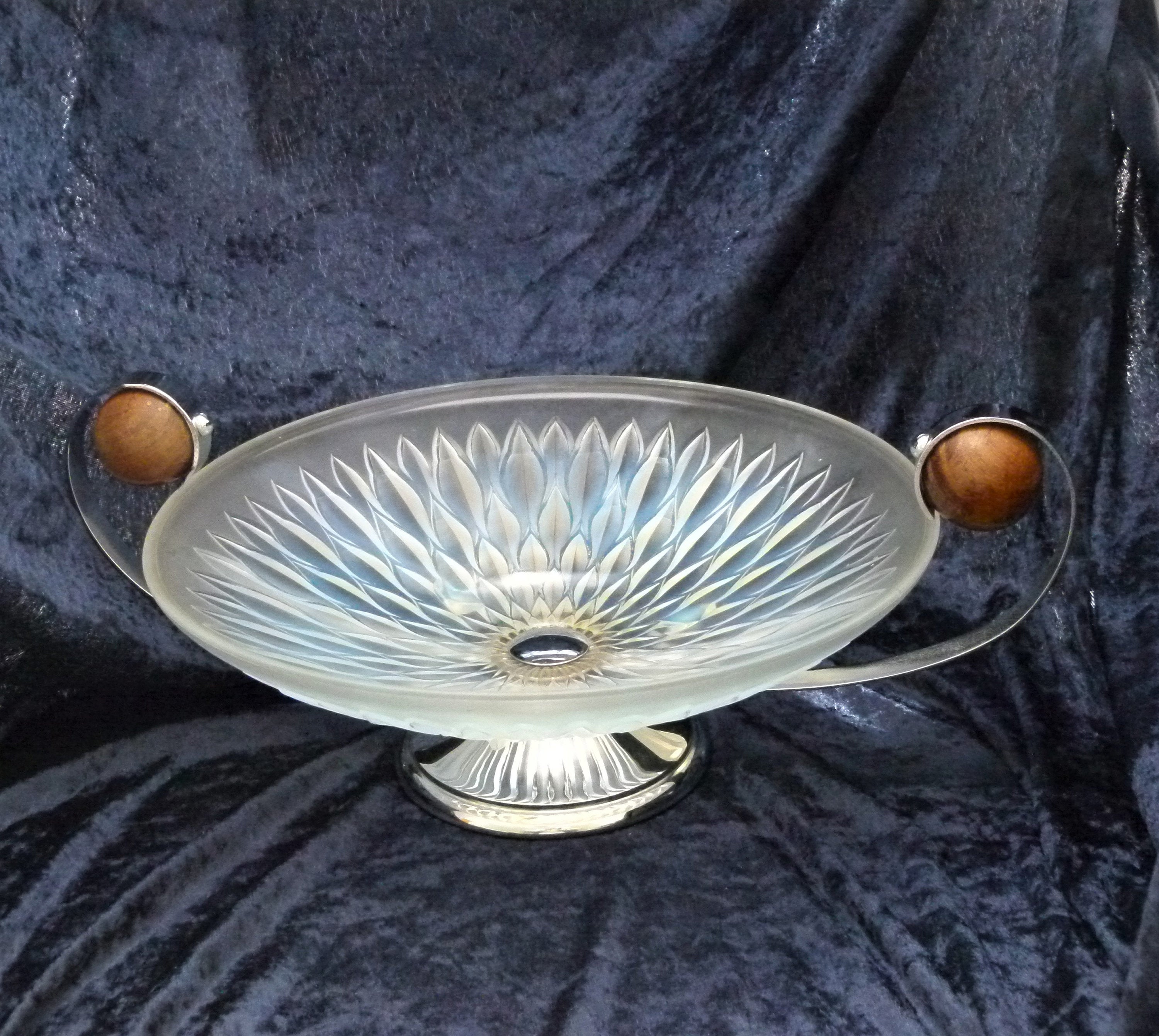
Within a few years he had built his own factory and turned that side project into an entirely new trade: the designer perfume bottle, made not as a single luxury object but by the thousand, so a beautifully designed bottle could sit on an ordinary dressing table. Through the 1920s and 30s his frosted, opalescent glass — vases, car mascots, clock cases, even glass wall panels for the ocean liner Normandie — became one of the defining looks of Art Deco.
Whitefriars: three centuries in London (1680s origins, closed 1980)
James Powell bought a small London glassworks, already old, near Fleet Street in 1834; it traded as Whitefriars, after the surrounding district, and its own roots are usually traced back to around 1680. In 1923 the firm moved out of the City of London to a new factory in Wealdstone, on the edge of Harrow — and it was there, decades later, that Whitefriars had its most unexpected moment.
In the late 1960s and 70s, under the designer Geoffrey Baxter, the firm abandoned restraint altogether. His 1967 "Textured" range was cast in moulds lined with tree bark, nails and wire, and finished in the loud tangerines, kingfisher blues and ruby reds of the period — glass that looked more like pop art than a Victorian tableware firm. Rising fuel costs and a recession closed the factory for good in December 1980.
Sweden and Denmark: the Nordic glassworks (Kosta 1742 · Orrefors 1898 · Holmegaard 1825)
Scandinavia's great glasshouses are older than they look. Kosta, deep in the forests of Småland in southern Sweden, was founded in 1742 by two former army officers who needed an endless supply of timber to fire their furnaces; it later merged with its neighbours Boda and Åfors to become Kosta Boda. Orrefors began in 1898 as a small ironworks turned glassworks nearby, and only found its identity in 1916–17, when it hired the painters Simon Gate and Edward Hald as its first in-house designers. Working with master glassblower Knut Bergqvist, they developed "Graal" glass — coloured decoration sealed for good beneath a thick, flawless skin of clear crystal.
Denmark's Holmegaard is older still, founded in 1825 beside a peat bog whose fuel supply was the whole reason the factory was built there. Its best-known modern designer, Per Lütken, joined in 1942 and stayed for fifty-six years, quietly shaping the soft, hand-blown Scandinavian look that so much mid-century Danish glass is still measured against.
Murano: seven centuries on one island (1291–present)
Murano's history starts with a fire risk, not an art movement. In 1291 the ruling council of Venice ordered every glass furnace in the city moved onto the island of Murano, ostensibly to protect Venice's largely wooden buildings — though a further law four years later, forbidding Murano's glassmakers from ever leaving the Republic, suggests the deeper concern was keeping the city's glassmaking secrets in.
That isolation produced centuries of unbroken skill, which the twentieth century reinvented rather than abandoned. In 1921 the Milanese lawyer Paolo Venini and the antiques dealer Giacomo Cappellin founded what became Venini, bringing modern design thinking to Murano's furnaces. It was there, in the late 1940s, that the illustrator-turned-glass-designer Fulvio Bianconi produced the fazzoletto, or "handkerchief" vase — asymmetrical, wafer-thin glass pinched to look exactly like a dropped square of fabric, now in the permanent collection of New York's Museum of Modern Art.
Paperweights: a Victorian fashion, twice revived (1845–1860, revived 20th century)
The glass paperweight is a surprisingly recent invention for something so associated with the Victorians. It is generally traced to 1845, when the Venetian glassmaker Pietro Bigaglia exhibited weights built from millefiori canes — bundled rods of coloured glass sliced crosswise, like a stick of seaside rock, to leave a tiny pattern in each slice — at an industrial exhibition in Vienna. Three French factories, Baccarat, Clichy and Saint-Louis, took up the idea and refined it into an art form.
Weights made in what collectors now call the "classic period," roughly 1845 to 1860, remain the most sought-after of all. Public taste for them faded almost as quickly as it had arrived, but the twentieth century brought a second wave of interest — from collectors, and from a new generation of makers determined to master the old canework by hand once again.
Further reading
A few places to check a fact, or to go deeper on any of the makers above.
- Whitefriars Glass: The Art of James Powell & Sons, edited by Lesley Jackson (Richard Dennis, 1996) — the standard reference on Whitefriars.
- René Lalique: Catalogue Raisonné de l'Œuvre de Verre by Félix Marcilhac (Les Éditions de l'Amateur, Paris, first published 1989) — the standard reference used to authenticate and date Lalique glass.
- International Modern Glass by Geoffrey Beard (Charles Scribner's Sons, 1976).
- Corning Museum of Glass — the world's largest glass museum, with a free online collection database and research library.
- Musée de l'École de Nancy — dedicated to Gallé, Daum and the Nancy circle.
- Musée Lalique — on the site of Lalique's own glassworks in Wingen-sur-Moder, France.