Orrefors: A Swedish master glass works
In southern Sweden, in the province of Småland, lies the Kingdom of Crystal, a land of lakes, rivers and forests where everything came together to produce some of the world's greatest glass makers. Names like Kosta, Boda, Strombergshyttan, Afors, Nybro, Maleras and, of course, Orrefors, are famous throughout the world and the glass that is made in this small corner of Europe displays the same clear cut lines and simple elegance that is synonymous with Swedish design worldwide.
Glass had been produced at Orrefors since the last years of the 19th century but it was in 1913 when an industrialist, Johan Ekman, bought the site, which included the glassworks, to obtain wood for his cellulose business, that the true beginning of the Orrefors history begins.

Ekman became fascinated by the glassworks and in the next few years amassed a team of blowers, engravers, engineers and designers, including the great Simon Gate and Edward Hald who were to be two of the most influential artists in the medium of glass. Although the Orrefors glassworks followed the trend for cameo glass like that of the French and Belgian factories, it soon became clear that new ideas were needed for this young company.
Gate was a traditionalist and Hald was a modernist but together they formed a formidable partnership and in the Ideal Homes Exhibition in Stockholm in 1917 finally moved from the old techniques to new ones, paving the way for other great designers such as Vicke Lindstrand and Sven Palmqvist.
Two techniques developed by Orrefors, designers and glassblowers working together, were Graal, developed from 1916, and Ariel, developed in 1937, both using effects within the glass rather than on the surface, somewhat like the techniques used by the great paperweight factories in the 19th century. These pieces generally command high prices and are often real works of art. The photo here is of the very popular 'Fishgraal' vase designed in 1937 by Edward Hald.
Another form of internal decoration was pioneered by Sven Palmqvist, who had begun his career as a glassblower before becoming one of Orrefors' leading designers. In the 1940s, he developed two techniques, 'Ravenna' and 'Kraka' which remain unique to him. In the vase here you will see the Kraka technique in this beautiful vase, the layers of glass being built up and the pattern being produced by the use of a mesh, rather than being engraved or sandblasted to produce an image.
Another name to come from Orrefors was that of the talented designer, Vicke Lindstrand, whose use of the human form, in particular the naked form, brought such works as 'Pearl Diver' and the vase illustrated here, 'The Water Skier'.
In 1990 Orrefors merged with Kosta Boda, in 1997 this became part of the Royal Scandinavia group and 2012, the glassworks at Orrefors finally closed.
Pieces of Orrefors glass, especially the iconic pieces like the 'Pearl Diver' vase, the 'Kraka' vase, the 'Fishgraal' vase and the charming and ever popular 'Wish to the Moon' vase, hold their value but there are less well-known items that collectors will always be looking for, pieces from the early 20th century especially. But for many, the thick-walled, deeply-cut and engraved pieces are the ones that epitomise the icy artistry of the company that grew up from the Kingdom of Crystal.
2 pieces by Orrefors that you can buy from our shop — others are available
UK delivery only.
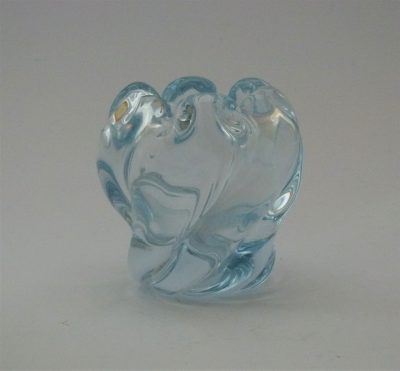
Orrefors blue tinted vase designed by Edvin Ohrstrom
A small vase designed by Edvin Ohrstrom for Orrefors in 1941 with thick wrythen ribbed walls which are pale transparent blue. The vase is signed and also bears the traces of a label. It weighs nearly 1100 grams, is approximately 11 cm in height and 11 cm in diameter. There are two minor surface scratches and the hint of some cloudiness as a water mark but this barely shows because of the colour.
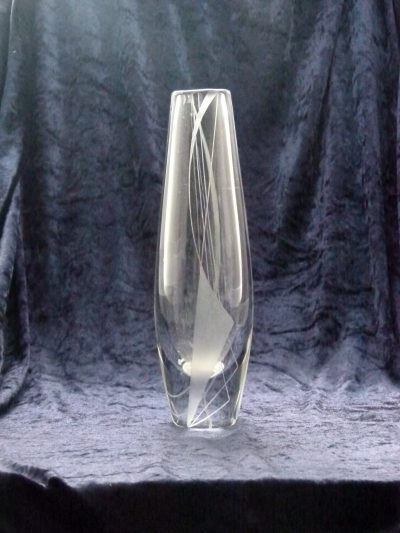
Tall Orrefors vase designed by Sven Palmqvist
This tall, stylish vase was designed in 1960 by Sven Palmqvist for Orrefors. It is signed but the Orrefors part is barely visible, the P3664 part being much clearer. The vase weighs 1700 grams, is 28.5 cm tall and about 8 cm at its widest point. The condition is good for its age but there are surface scratches. This is reflected in the price. Ref. Scandinavian Glass 1930-2000, Smoke & Ice, p.99.